
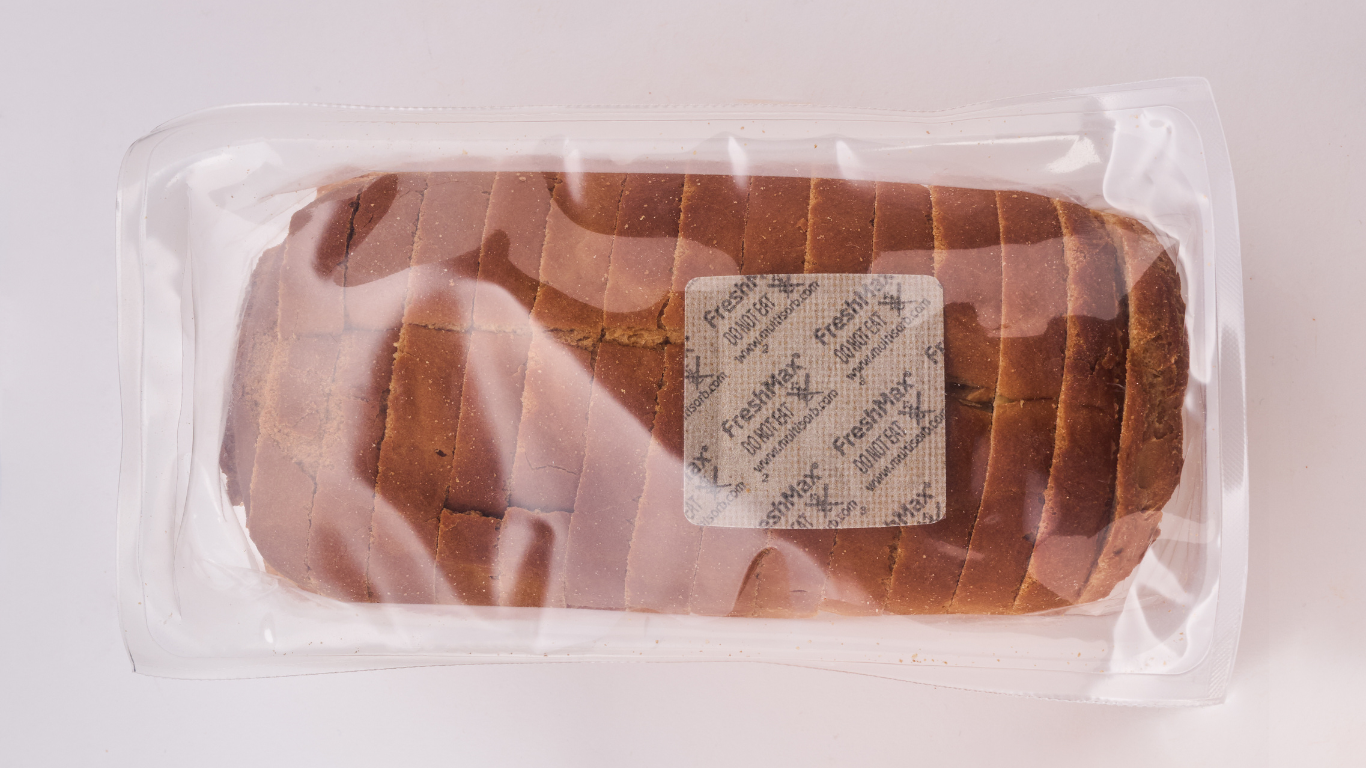
Less Waste. Longer Freshness: How Active Packaging Helps Extend Shelf Life
What You’ll Learn
- How moisture, oxygen, package permeability, and environmental conditions can influence food quality and shelf life.
- How active packaging technologies can help manage the conditions inside a package to protect freshness.
- Why active packaging is not one-size-fits-all and which product and packaging variables should be evaluated when designing a solution.
- How material science, testing, and predictive analysis can support better packaging decisions from development through commercialization.
- How extending shelf life can help reduce food waste while improving the efficiency of the resources used to manufacture, package, transport, and store food.
Freshness does not stop changing when a food product leaves the production line.
Once a product is sealed inside its final package, a new environment is created. Moisture can move between the product, package headspace, and surrounding atmosphere. Oxygen trapped during packaging or entering through packaging materials can contribute to oxidation. Temperature fluctuations during transportation and storage can accelerate these reactions.
For food manufacturers, extending freshness therefore requires more than selecting a packaging material or increasing the barrier properties of a package. It requires understanding the relationship between the food product, packaging system, environmental conditions, and desired shelf life.
Active packaging can provide another level of protection by helping manage specific conditions inside the package throughout the product’s intended shelf life.
With more than 65 years of experience in active packaging, Multisorb combines material science, sorbent technology, testing, and application expertise to help manufacturers design protection around the needs of the product.
Understanding What Happens Inside the Package
Food quality can be affected by multiple physical and chemical processes after packaging.
Two of the most important variables are moisture and oxygen.
Moisture is constantly seeking equilibrium. Depending on the food, packaging material, relative humidity, and storage environment, water vapor may migrate into or out of a product. Even relatively small changes in moisture can affect characteristics such as crispness, texture, flowability, appearance, and overall product quality.
Oxygen creates a different challenge. Oxygen may remain in the package headspace after sealing, be dissolved or entrained within the product, or enter gradually through the package material and seals.
For oxygen-sensitive foods, this exposure can contribute to oxidative reactions that affect flavor, aroma, color, nutrients, oils, and other sensitive ingredients.
Barrier packaging can help slow the movement of moisture or oxygen, but it does not necessarily eliminate what is already present inside the package. Additionally, packaging materials have measurable transmission rates, meaning moisture vapor and oxygen can continue to enter a package over time.
This is where active packaging becomes an important part of the overall packaging system.
Managing Moisture and Oxygen with Active Packaging
Active packaging is designed to interact with the environment inside a package rather than simply creating a passive physical barrier.
Desiccants adsorb moisture within the package environment. For moisture-sensitive foods, the appropriate desiccant system can help maintain conditions that support desired texture, stability, and quality throughout shelf life.
The amount of moisture protection required depends on factors including the product’s initial moisture content and water activity, package volume, packaging material, water vapor transmission rate (WVTR), expected storage conditions, and desired shelf life.
Oxygen absorbers address a different mechanism. Rather than simply limiting oxygen transmission through the package, oxygen-absorbing technologies can remove available oxygen from the package environment after sealing.
This can be particularly valuable when oxidation contributes to changes in flavor, aroma, color, nutritional quality, or overall freshness.
In some applications, both oxygen and moisture must be managed. The challenge is determining which conditions are contributing to product degradation and how much capacity is required to manage those conditions over the entire intended shelf life.
The Right Solution Starts with the Application
One of the most important principles of active packaging is that more sorbent does not automatically mean better protection.
The solution should be designed around the application.
For example, two products packaged in containers of similar size may require very different active packaging solutions because their formulations, water activity, oxygen sensitivity, packaging materials, distribution environments, or shelf-life targets are different.
A technical evaluation may consider:
- Product characteristics: formulation, initial moisture level, water activity, oxygen sensitivity, oils, flavors, and other ingredients susceptible to degradation.
- Package configuration: package dimensions, internal volume, headspace, closure system, seals, and the location of the active packaging component.
- Barrier properties: oxygen transmission rate (OTR) and water vapor transmission rate (WVTR) of the packaging materials.
- Environmental exposure: expected temperature and relative humidity during manufacturing, warehousing, transportation, retail, and consumer storage.
- Target shelf life: the length of time the product must remain within established quality parameters.
- Sorbent performance: adsorption or absorption capacity, kinetics, and performance under the application’s expected environmental conditions.
Looking at these factors together allows packaging teams to move beyond simply asking, “Which absorber should we use?” and instead ask, “What conditions must we control, for how long, and under what circumstances?”
That is a much more useful question when designing for shelf life.
Packaging Protection Backed by Material Science
Selecting an active packaging solution should not rely on guesswork.
Material science and testing can help quantify the protection a product requires and evaluate how a proposed packaging system may perform over time.
Multisorb’s technical approach can include evaluation of the product, package, environmental exposure, and sorbent requirements to help manufacturers identify potential risks before commercialization.
Testing and technical analysis may also help manufacturers compare different package configurations, barrier materials, sorbent capacities, and storage conditions.
For example, increasing the barrier performance of a package may reduce the amount of oxygen or moisture entering during storage. In another application, an optimized active packaging component may provide the required protection without unnecessarily increasing package complexity.
The goal is not simply to add an absorber. It is to create a packaging system in which the product, passive barrier, and active packaging technology work together.
That systems-based approach can help manufacturers make more informed decisions during package development, reformulation, material changes, or shelf-life extension projects.
Extending Shelf Life Can Mean Reducing Waste
Shelf-life extension is not only about keeping a product on the shelf longer. It can also affect the efficiency of the entire value chain.
When products maintain acceptable quality for a longer period, manufacturers and retailers may have greater flexibility in production planning, inventory management, transportation, and distribution.
Most importantly, protecting food from premature quality degradation can help reduce avoidable product loss.
Every food product that is discarded represents more than the product itself. It also represents the ingredients, energy, packaging materials, manufacturing capacity, transportation, and labor used to produce and distribute it.
Improving product protection can therefore support both commercial and sustainability objectives.
Start with the Science of Your Product
There is no universal formula for extending food freshness.
The right solution begins by understanding why a specific product loses quality, how the package environment contributes to that change, and which variables can be effectively managed.
With more than 65 years of active packaging experience, Multisorb helps food manufacturers evaluate those variables and develop solutions based on their specific product, package, distribution environment, and shelf-life objectives.
Because better shelf life does not start by adding more packaging.
It starts by understanding what your product needs to stay protected.
Less waste. Longer freshness. Better protection.
Ready for Better Protection for Freshness?
We help food manufactures understand what their product needs to stay protected.